Welcome to my birding blog - first launched 12th March 2012...
Sunday 21st April ff
All's well that ends well...
Sunday 21st April: I missed one out!
Hark back to Saltholme. I saw a few yellow wagtails but forgot to include this photo.


Tuesday 23rd April
Ok. Next was a disastrous trip to Gibraltar Point to see a lifer: a western subalpine warbler. Got there 7.30am. Never saw the bird. The place has let me down before: once for a sora and once for a dowitcher. Gibraltar Pointless for me. Very disappointed birders all round. Picked up a lesser whitethroat tick taking me to 197 for the year. Here's a few photos.
 Some shelduck were having a real fight. Caption: [Tufted duck speaking] 'Gosh, this is exciting!'
 You know when there's a fight in the playground and everyone gathers round? Well, this tufted duck was actually applauding the combatants. Look!
 Called at Blacktoft on the way home feeling rather dispirited. More conventional shelduck portrait.

Wednesday 24th April
Needed to have a break. Photographed some wild flowers locally.
Lady's smock or Cuckooflower Cardamine pratensis
 Marsh marigold Caltha palustris
 Wood anemone Anemone nemorosa
 The true wild daffodil - Narcissus pseudonarcissus - short stemmed with generally paler lemon yellow flowers
 Celandine [technically lesser celandine] in an unusual double form: Ranunculus ficaria flora pleno. Ranunculus tells us it's a buttercup really!
 Fritillary Fritillaria meleagris or snake's head fritillary. One of those plants for which we don't really have an english name other than a form of the latin one.

Friday 26th April - Will Spurn deliver the goods?
After the disappointment of Gibraltar Point I was unsure whether to get up early and head for Spurn - feeling the Rufous-tailed Rock Thrush would be long gone by the time I got there. But I decided it would be silly not to try. After all a lifer was at stake.
Now a female rufous-tailed rock thrush isn't as pretty as a western subalpine warbler: in fact it's a bit like a cross between a juvenile starling and an overweight female redstart. Behaves a bit like a redstart: jumps up and down from fence to ground and back and - you guessed - I saw it. Always a bit distant for my lens but clear enough I think. Here she is: on the boulder clay.
 On the fence. I like this picture because you get three for the price of one and good size comparisons too! Reed bunting and meadow pipit included for good measure.
 Putting aside rumours of a hoopoe that had flown off in the direction of Beacon Ponds I headed for Canal Scrape where, someone said, a long-eared owl was showing. Although well inside the hawthorn it was easily spotted.

Whilst sitting there I watched some pied wagtails suddenly I realised one in front of me was quite unusual - although clearly a white wagtail I have never seen one with so little black, especially on the head. Looking at other photos in other books etc. this bird is very grey and, I think, very smart.

 I've included a rear view to reinforce the point!
 More wagtails flew in. It became a bit of a wagtail-fest as they strolled about in front of the hide. Lovely photo opportunity!


 Kilnsea Wetlands was very quiet. Dandelions were in flower and a meadow pipit posed nicely.


Saturday 27th April: scamper to Wales!
Another western subalpine reported in a field at Uwchmynydd near Aberdaron in North Wales. A phone call to my mother-in-law and I was expected for the night. Leaving York at 4.30am I was parked on the grass by the sheep field where the bird had been reported. What's more, I had parked there many times before. I knew the place well. I watched the linnets, wagtails and meadow pipits round the car wondering just where the bird had been seen. It was cold and the sun was shining so the temperature was slowly rising.
I spotted a chough digging at the far end of the field.
 Navelwort was in flower. This succulent perennial grows well in North Wales. The leaf explains the name and the latin name is telling too: umbilicus rupestris!

 Took me some time to track this plant down. I believe it is Alexanders, smyrnium olusatrum.
 I watched a man with a scope on his back as he headed down the road from the summit.
'Seen the warbler?' he asked.
'No,' I replied. 'I've been photographing the chough and the wheatears.'
He spotted the chough I meant. The bird had plastic rings. 'Just need to get the detail of those rings,' he said. 'Right, follow me!'
Wheatear everywhere. The patch birder said there had been a fall of well over 80 Greenland wheatear and they were literally on every bush and on the grass around us. And quite skittish too. Only my second fall ever, the previous one being of siskin at the Crown and Anchor pub, Kilnsea.


 Whenever something moved it was a wheatear or, once or twice, a dunnock. Then the birder said 'There!'
Lifer 392. Eight more for the magic number...


 I went back east towards Llandudno to go up the Great Orme and see what was about but I called first at Dinas Station on the Welsh Highland Railway. No trains were due but I took these photos.
 Awaiting restoration but with a brand new tender, this South African NG15 class 2-8-2 was in the yard.

Once I made it to the Great Orme there were more wheatears on the limestone pavement. They camouflage really well. Spot him?
 Snowdonia from the limestone pavement.
 Jackdaws are the most common bird up there but a change of tone alerted me to another bird.
 There was still snow on the mountain tops.
 The rest of the day passed uneventfully but pleasantly. I was very happy I had decided to go for it - just a pity my friend Barry couldn't come. I headed west for Llanengan via the Foryd Bay coast road. I spotted some waders out on the mud some way off. That beak shape was unmistakable. Four whimbrel. [Only one in the photo!]

The Rivals from Foryd Bay
 Sunday 28th April: homeward bound!
The weather was deteriorating into rain but I called at Conwy RSPB in case the reed warbler I had heard the previous day was showing. No: still singing deeply hidden in the dead reeds that haven't shown any signs of regrowth yet.
Cowslips - primula veris - were in flower. This clump was most impressive.
 My first swift of the year flew past at lightning speed. I decided to try a bit more swallow catching. So to end the pictures of this blog here are some more swallows...and a sand martin.


 Sometimes the shapes the swallow can assume are amazing.

Monday 29th April
A sad day. We went to Leeds to call on our son. On the journey back Tiggy fell ill and her on-screen announcement sounded bad. 'Engine fault. Workshop!' We left her at the VW dealership and went home in a courtesy car whilst we waited for news.
An afternoon trip to Fairburn to look for a wood sandpiper - driven there by my wife in her car - was unsuccessful. Hopefully my next blog will have better news of how Tiggy is feeling. Perhaps she'll go somewhere nice to recuperate!
UK 2013: 203
Lfe list UK: 392
Wednesday 17th April following
1: And I'll huff and I'll puff and I'll blow your house down!
Well, it hasn't done that yet but I am honestly tired of wind - it seems to have been blowing for ever. Maybe the prophets of doom are right and the world is getting windier. Just wish it would hold off for a while!
Went to Old Moor on Wednesday 17th April to look for terns: saw common tern and a willow warbler was singing loudly by the first hide. Eventually I tracked him down deep in the scrub. First one of the year.

2: What colour is a polar bear's skin?
It's one of those old chestnuts isn't it? Something to impress your friends or maybe bore your colleagues with. Like what does a banana share 40% of its genes with? Answer: human beings! I expect every living thing shares about 40% of its genes with every other. Not just bananas.
Oh well, anyway, on Friday 19th April I went somewhere new to me: Scorton Lakes near Catterick. It is a series of gravel pits that are being converted to wetlands. They are still very raw but I saw little ringed plover and, after a lot of searching, an arctic tern. When I arrived a birder said he had been watching the tern fly around the far end of Banks Lane lake but had lost it. I found it resting on a rock in the sunshine by slowly scanning my way round. The vantage point is very good but you need a telescope: it's a large area - with promise for the future! Car park at SE242995 called Scorton Walk car park.
Chaffinches accompanied my walk back. Celandines were flowering in the sunshine.
 I went on to Saltholme where I had distant views in the heat haze of drake garganey and brief views of sedge warbler [singing loud and clear] but skulking in the brambles - perhaps still recovering from the journey.
Other birds showed well including wheatear and avocets.


 The Saltholme fox gets everywhere and is completely unafraid as this photo shows!
 On the following day, Saturday 20th April I went to Deer Hill reservoir looking for twite and then on to Blacktoft. Let's start at Deer Hill. I set off on the gradual climb up to the dam - it's about three quarters of a mile I would guess. This pony needed his Dinky Rug on what was a frosty start! Memories of Uyeasound...
 Lapwings were nesting.

Wheatear and snipe were around too...
 ...and lots of meadow pipits.
 Eventually I found the twite at SE068117. Here's my twite portfolio. Look out for signs of the red rump of an adult bird.
The twite kept retreating to the wires.

The books say twite have a quite deeply forked tail.


 One was bound to be ringed!
 Swallows gathered on wires near Tiggy.
 Some whimbrel flew over the water but I think this is a curlew...
 From there I drove along the M62 to Blacktoft. One of the perils of photography is that sometimes you don't realise what is spoiling the shot. Take for example this shot of a little grebe equipped with a new digital aerial!!
 That's better!
 Geese abounded.
 You never go to Blacktoft without seeing the harriers.

 Snap!

Last lap. Sunday at Saltholme and co. A couple were showing their alpacas to the locals at RSPB Saltholme.


 I was after other things. A distant common sandpiper was target #1.
 The fox turned up yet again.
 I had seen a whitethroat at Dorman's pool briefly earlier but was very pleased to get these photos of the black-necked grebes as they came in close.


 Day finished with a little tern battling the wind at South Gare.
196 UK 2013
Oh yes, the polar bear has black skin! Not a lot of people know that!
Monday 8th April-Monday 15th April 2013
Action stations!!
Many years ago I was amused to learn that the Italian navy's equivalent command for Action stations! was Panica generale! So, Panica generale! The birds are here. At last.
On Monday 8th April I left for a week in Wales where I would take my mother-in-law and friend to Llandudno for a couple of days, stay at her house and 'bird' North Wales before taking her home again and then returning to York on the Friday.
I started by going up the Great Orme by 8am on the Monday having left home before dawn. I soon saw wheatears and choughs and hundreds of meadow pipits. They were everywhere, almost under your feet. I had hoped for ring ouzel, but no sign. There was still quite a lot of snow on the summit. Where it had drifted aginst the stone walls it looked like wedding cake icing - it was so clean.
 Heading west along the North Wales coast I took a favourite detour along the narrow Foryd Bay estuary road. I was thrilled to come upon a flock of over 30 sandwich terns.


 The Glaslyn Osprey Project was my next stop. The birds are not easy to see, even with a scope, from the RSPB site but, if you are lucky as I was, if one of the pair flies off south you can get good views. The next photo shows the nest site: the right hand flat topped pine in the centre. I've started carrying my old Nikon 4500 for general views.

Next stop on day one was Pwllheli marina. If the tide is low there are always some good birds to see.
A pair of shelduck were displaying: the female briefly feigned indifference.
 A heron let me get close as I looked down on him from the promenade.

 A little egret was around too. This was the first time I've seen hostility between a grey heron and an egret. The heron chased the egret off but it only went to the other side of the stream that flows into the marina. I took this nice sequence.


 Always have a cod liver oil capsule for tea!
 Oh no, sorry, it's a tiny fish!

Porth Meudwy was the last port of call on the Monday: this secluded valley from where the boats go to Bardsey Island is a migrant hotspot so I walked in hope down to the cove. I saw a few warblers - all chiffchaff as far as I could tell. None was singing. This one was by the stream.
 On a bank beside the path these primroses told me that spring had truly arrived and the sun was shining.
 Tuesday was to be Anglesey day but in spite of my efforts I only picked up one year tick but it was my main target: black guillemots in Holyhead fish dock.
 On Wednesday I decided to go up onto the Great Orme again and with much less wind I hoped for some photos. Good decision!
 Within its own fenced off area I saw lots of dead carline or alpine thistle carlina acaulis. They dry beautifully.
 The birds were showing better too...
Wheatears began to pop up everywhere.


 Stonechats too. Everywhere the grass was winter-brown.

 Always indcate before flying off left!
 But it was the female stonechat that proved most enchanting.

 I also saw 2 ring ouzels but they wouldn't stop for a photo. Twice I raised my camera to focus to find the bird had already slipped away!
RSPB Conwy is nearby so I dropped in for a walk round. A heron popped his head up from the reeds and stared at me. I'm not sure who was most surprised! Seconds later he screeched and flew.
 In a shady spot I spotted some flowering blackthorn prunus spinosus or sloe. Called blackthorn because of the very dark stems. Whitethorn is often applied to hawthorn but some, understandably, call blackthorn whitethorn!
 A group of jackdaws were on the grass outside one of the hides.
 An oystercatcher was bathing. It obviously helps to keep your bill out of the water when you are almost completely submerged!

 As I walked on towards the estuary I saw a large bird in a tree. As I raised my bins a buzzard flew off low past me. I had trouble with the focus lock but these are passable.

 A lesser black-backed gull was standing in the shallows with three other lessers. Sand martins also seen.
 I walked back to Tiggy along the Afon Conwy estuary. A curlew was backlit by the sun.
 Thursday 11th April was a little embarrassing: battery failure on both cameras! I was happily photographing the morning's first train up the Welsh Highland Railway out of Caernarfon. So as a diversion, here are all I managed that day.

 Beyer-Garrett 2-6-2 + 2-6-2: what a loco!


 Imagine my surprise when I got back to my mother-in-law's house when I saw a blackcap on a suet cube in the adjoining garden. I had heard that a strange bird had been seen and I had been watching for it. I was up early next morning, recharged camera on my lap as I sat in the conservatory. These photos taken through glass show my 8th tick of the week.

 Last day of my visit. I called at Conwy again in the rain. First swallows of the year - quite a lot of them. I practised that most difficult of skills: tracking hirundines. Alas, the light was poor but the shapes are still fabulous. Look at how the tail shape changes...
 Since posting the above photo on Bird Guides yesterday [17/4] it has become the most voted for photo I have put on their site with 38 votes.

 Skim drinking!

 Sand martins too.

 A merganser cruised around.
 A marsh harrier [which I never saw but others did] put up all the waders. First the redshanks.
 The curlews.
 The little egret.
 The lapwing was, unusually, the last to go.
 After a couple of days' enforced break I went up to Fence Houses near Houghton-le-Spring for a top quality bird: a little bunting. This bird was very hard to photograph as it skulked in the undergrowth by a stream but here are my best efforts. At least you can see what a little stripey thing it is!


 Later I called at Saltholme and saw one house martin, one green sandpiper and a white wagtail.
 This reed bunting was quite confiding.

 Ubiquitous redshank was much closer than the greensand.
 The Shetland sheep had little lambs.

 And a fox wanders the reserve. Better keep an eye on your lambs, mum!

Postscript
Monday 15th April: dashed to Flamborough North Marsh to see the mega Baikal Teal. Distant and so many people in tiny hide couldn't get a photo but it was, nonetheless, lifer 390.
2013: 185 and counting.
Monday 1st April-Friday 5th April 2013
April Catch-up Blog!
This could refer to a seasonal catch-up after a winter that has definitely outstayed its welcome but it doesn't. I simply meant that I had been so busy - not just birding- that I find myself facing a backlog of photos to post and a long blog to write. So here goes. Hope you like some of the images from early April.
On the first of April
I went down to Fairburn in the afternoon to see what was about. After a fruitless walk down The Cut I called at the visitor centre feeders...
Siskins were there.

 Long-tailed tits were nearby too.

A number of smart looking male reed buntings were feeding on the ground.


Tuesday April 2nd
Barry and I went up to Hartlepool in the afternoon. We found things very quiet. Spion Kop cemetery was free of any birdlife. The gravestones were left in peace.
 The North Gare access road produced a few of the usual suspects, notably a friendly curlew. Funnily enough the photos I took as he walked along aren't as sharp as I would have liked. I snatched a few more as he took off. They seem quite nice.


Wednesday April 3rd - A Birthday Surprise
My wife loves owls - she's a bit of an owlaholic. So, in January I made contact with a local bird of prey centre to see if they could do a home visit and bring along some owls... Well, that's what happened today. As ever, I shall let the pictures tell the story.
Many thanks to York Bird of Prey Centre Ltd.,
trading as Minster Falconry 07977318480 & 07772315757
White-faced Scops Owl


 Seeing a cat in the garden the owl became fully alert and changed shape!!


Tawny Owl


 Eagle Owl


Barn Owl


In the afternoon we went to Fairburn. We failed to find the long-eared owl to add to our collection and this pale lesser redpoll didn't quite fit the bill to be a 'Mealy'.
 A few siskins were still around but I didn't see any smart males.

Thursday 4th April
Back to Hartlepool with Barry! If at first you don't succeed, keep going! Well things started well with a lifer for Barry - a lesser scaup at the triangle pool at Saltholme. See Barry's blog for the full report. http://barryjohnbishop.blogspot.co.uk/
In the cemetery at Spion Kop I noticed how many gravestones told the sad story of infant deaths. This one is very sad but it must be as good a place as any to lie - within a modern-day nature reserve at peace with the birds. Quite appropriate for a surname like that...
 Just inside the harbour we saw the red-necked grebe as it disappeared into the fish dock. A few birds were on the shoreline inside the pilot quay. Curlews.
 And an eider masquerading as a curling stone.
 What's this then?

On the Headland we spotted a group of eiders on the sea together with another bird, a red-throated diver, asleep. Looks like another curling stone...
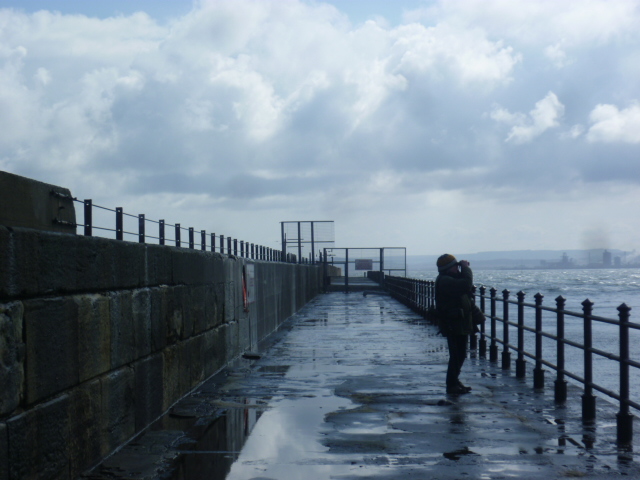
In order to get nearer I ventured along the jetty, risking a soaking as waves broke over the wall behind me. Barry took this hoping to catch me getting drenched!!
Here are the birds: eiders first, in flight.


 Red-throated diver in dazzling light.


 Further round the Headland we saw waders...
Redshanks

 Purple sandpipers


 Ringed plover
 We could hear sparrows in the gardens on the Headland but eventually Barry spotted one up on the guttering. Looks pleased with himself.

We called at Ward Jackson Park but things were pretty quiet there. A lesser black-backed gull was floating on the lake [pond].
 Finally we walked round Tilery Wood but all the birds were hiding. At least we could boast we had walked all the way from Cleveland to County Durham!

Friday 5th April
Where now? Old Moor and Co. First call Broomhill Flash where our target birds were not at home. Redwings were in the field across.

 I stocked up with bird seed at Old Moor and we watched yellowhammers, brambling and bullfinches on various feeders before heading for Fairburn to see what sort of redpoll they had on their feeders...
No, not that kind; that's a nuthatch.
 And that's a treecreeper on the wire netting!
 Could be my best ever treecreeper shot even if it is rather inappropriately located. Postcreeper!
 Ah ha! What's this then? A male siskin!
 At last! A lesser redpoll.
 Some paler fellows with orange polls! [Apparently not unusual] see:- http://birdingfrontiers.com/2012/06/23/more-on-those-pesky-redpolls/


 Looks like a mealy redpoll to me.
Round by Pickup hide I saw the cormorant trees covered with cormorant guano [for want of a nastier word]
 Fieldfare were cackling in the trees. About time they left!!
 Back at the Visitor Centre a greenfinch posed behind some twigs so the results were all blurred. He took off and I kept shooting. One of those rather fortuitous outcomes. I can't help liking this image a lot!
 Down below a pheasant posed nicely in the sunshine. 7 degrees!!
 Right, that's it. Up-to-date. Done.
UK 171 2013
Wednesday 27th March ff
Always look on the bright side...
Eric Idle: Monty Python's 'Life of Brian' 1979
Wednesday 27.03.13
Not much happening today until younger son arrived with friend for experimental photo flight of their new quadcopter. What's a quadcopter? Well it looks a bit like this with a lot of extras attached for the camera and transmitters.
Still Malcolm took some pictures of the area near our house. Here's one of them: it's a sort of goose eye view.

Thursday 28.03.13
Barry and I went off to Arram, Hornsea, Barmston, Bridlington, Bempton, Scarborough and even Forge Valley for our 65 strong day list. See http://barryjohnbishop.blogspot.co.uk/ for the full story! Pictures begin then with Bridlington harbour where this very alert redshank was standing to attention. Lots of dunlin were running around on the mud. It was low tide.


 The long-staying [feral?] barnacle goose was still present.
 We peered over the harbour railing at a herring gull below. He peered back at us!

Next stop Bempton Cliffs RSPB to get a razorbill tick for Barry. No puffins unfortunately. [Oh yes, these are guillemots of course]
 I was soon fascinated by the fulmars as they bounced on the wind near the cliff face, floating at times on the currents of air.


 North to Scarborough to Holbeck where we fed the mediterranean gulls [and black headed too!] and captured the meds for posterity...


 Velvet scoter from this viewpoint too - out in the bay beyond my lens of course.
Last shots from Scarborough Mere where the red-crested pochard came steaming in at speed only to paddle away equally rapidly. Still, got this sharp one.
 Final one of the day of a female tufty - don't suppose they get photographed very often...

Friday 29.03.13
Again, read Barry for the story. It was another helter skelter round Yorkshire starting at Withernsea for a lapland bunting [we hoped] and some snow buntings. Eventually Barry found the snowbunts.
 Pictures only record shots as they were not very approachable. No sign of lapland bunting but I counted 10 birds in the air and reports generally mentioned 9 snow buntings. Well, careful counting of this image [I'm sorry they are blurred] shows ten snow buntings.
 On to Kilnsea for lots of birds including these Brent geese.


 Skylarks overhead. I shot a few...going up...
 ...and coming down!
 No, I haven't turned the picture round. This is as it descended. See the tail stripes!
 Finally Barry spotted a little gull at Hornsea Mere. We get around don't we? More than you think - in between times we'd been to Arram to see the ring-necked duck. Anyway I was thrilled with this little gull.


Saturday 30.03.13
I went to Stapleton for a jack snipe which I didn't see and to Scarborough for a black redstart which I also missed. However something always happens to surprise me.
Not this peregrine up on the cliff on Marine Drive.

 I'd been watching the cliff with my back to the sea. Something made me turn round: maybe the increased noise of the gulls. A kittiwake was trying to persuade a seal to share a large fish with him...
 As you can imagine, soon other birds wanted a piece of the action and of the fish. Just pictures....

 Kittiwake partially submerged by this point.


 Aren't greater black backs huge!
